Ephemeron Genealogy →
The work

A music living organism

Ephemeron is a music living organism. During each concert, the work is born, evolves, and dies at the end of the performance. The performance space, including the audience, is the “natural environment” of this music organism. This music organism is fed from the sound of its environment through microphones while it feeds back the environment with sound through the speakers. Music organism and the environment are an interconnected and inseparable ecosystem.

There is no pre-recorded material at any stage. The work emerges as a music organism from the interactions among space algorithm and (if any) user-performer. In the original version, the initial material of the composition is the applause coming from the previous piece.

Ephemeron was commissioned by the Z.K.M. institution and saxophonist Pedro Bittencourt. Originally, it was conceived as a real-time electronics “concert work”. It was initially developed in the concert hall of Z.K.M. Karlsruhe and the Maison de Science de l’Homme/Université de Paris 8. It premiered at Z.K.M. Kubus Concert Hall.

Ephemeron has been presented as a concert piece or installation numerous times worldwide. The algorithm has become an ecosystemic music instrument, the backbone of several projects of Kollias.

In 2026 Ephemeron was reborn as a web page, computed in the visitor's browser: Web-Ephemeron.

A drawing of the 2008 structure: 3 organs of 4 tissues, each tissue with 2 cells. A click claps into a simple model of it. The work itself runs in the frame below.
The work, live

Web-Ephemeron 2026

In 2026 Ephemeron was reborn as a web page, computed in the visitor's browser. It runs in any current browser, desktop or mobile.

Web-Ephemeron (2026), running live above. The current version of the work, embedded from the artist's site. Press play inside the frame.
In his words

The music of here and now

We normally listen to music of the past and of another space, but with Ephemeron it is the music of here and now.
All sound material results exclusively from different types of live feedback, caused by the interaction of microphones and speakers through the space. Space, performers and audience become one music entity.
Description of the work, 2013
The work is born in the particular context of performance in which it also dies. The ephemeral character of any musical work is exemplified here.
Organised Sound 16(2), 2011
Life
The concept of the work is a live music organism emerging during the performance from the interactions among the genetic code of the organism (the algorithm) and its environment (the acoustic space).
Re-New, Copenhagen, 2012
Self-organisation
In self-organizing music, being also an artificial creation, there is always a level in which control is applied before we let the work regulate its own processes.
Organised Sound 16(2), 2011
Artificial intelligence
Often perceived with suspicion, AI applications can be criticised for sterilising music expression through artificially constructed music of inhuman algorithms. On the contrary, we can claim that the machine comes as a liberator of the individualistic and authoritarian regime of the composer.
EMS21, Leicester, 2021
The way we listen
Microphones wide open were listening to you, listening to all of you. You were a unique unit of the audience with your unique perception.
Programme note, quoted in the SMC08 paper, Berlin, 2008
The way we create
Even though the composer controls the communication between the system and its environment, he loses control over the final result.
SMC08, Berlin, 2008
What is the listener's creative role in the work's creation and how is the role of the composer transformed?
EMS21, Leicester, 2021
The life of the work · 2006–2026

The story of an algorithm, and of the composer who lives beside it.

A live-electronics organism, built in Max/MSP since 2007 and fed by the sound of its audience. Its notes, its saved versions and its rooms show how it grew, and how his role changed around it.

1,947 saved versions, one bar per month

A patch is a program in Max, the music software the work is written in. The busiest month, March 2008, comes just before the premiere. Click a bar to jump to its chapter.

saved versions of the patch, per monthdated showingsthe 2026 web branches, not counted in the bars

Hover or tap a month.
I

Roots

2006–2007
The organismA network of controllers that overloads and cancels itself
The composerA Master’s student in Paris, at the desk

He studies Agostino Di Scipio’s feedback systems in Horacio Vaggione’s class. A diary in Greek records each attempt.

19 August 2007: the system overloads and cancels itself. He finds the fault in his own code. 30 August: Di Scipio’s system saturates after 8–9 minutes, he notes.

16 October 2007: he decides to replace four subsystems with many small elements.

“Μεγιστοποίησε τον αριθμό των στοιχείων και σμίκρυνε όσο γίνεται τις ευθύνες του καθενός. Θα χουμε ένα πολύ ωραίο χάος. Αν πιάσει πάμε για πιο κοντά στη βιολογική αυτοοργάνωση.”
Maximise the number of elements and shrink each one’s responsibility as far as possible. We will get a lovely chaos. If it works, we move closer to biological self-organisation.
Systems diary, 16 Oct 2007
II

Birth

2008
The organism3 organs, 4 tissues, 2 cells: 24 delay lines fed by applause
The composerThe composer who builds a lifeless seed and lets it go

February 2008: a memorandum for a ZKM commission. Code name: «La Mer auto-organisée» (the self-organised sea).

Pedro Bittencourt proposes the slot. The system enters between pieces, in the applause.

25 April 2008, ZKM_Cube, Karlsruhe. Four microphones listen to the applause, and 24 cells answer through 20 loudspeakers. The programme note ends: “The audience now is spread. The organism is no more here.”

Milestones
  • 2008Commissioned by ZKM and saxophonist Pedro Bittencourt. Premiere at ZKM Kubus Concert Hall, Karlsruhe.
“φτιάχνουμε ένα σύστημα στατικό από το οποίο θα αναδυθεί ένα δυναμικό σύστημα. Ποιητικά: η γέννεση ενός ζωντανού συστήματος μέσα από ένα άψυχο.”
We build a static system from which a dynamic system will emerge. Poetically: the birth of a living system out of a lifeless one.
Memorandum des expériences systémiques, 2nd season, 12 Mar 2008
III

The concert organism

2009–2013
The organismIt travels, plays beside a saxophone, then restarts from one cell
The composerA performer at the laptop, on stage with it

Leicester, Porto, Paris, Karlsruhe, Rhodes, Copenhagen. Each room gives it a new body, from 2 to 21 loudspeakers.

2010, ZKM: it plays with a saxophonist. His aim: «faire une version auto-organisée, capable à réagir avec le saxophoniste» (a self-organised version that can react with the saxophonist).

15 December 2011, MSH Paris Nord: he rebuilds it from one cell. Versions 10.5 and 10.5.1 fail. Then 10.5.2: «ΔΟΥΛΕΥΕΙ!» (it works!).

24 September 2012, a self-critique: “Can the composer escape from representation?”

Milestones
  • 2010Tape version at SoundCrawl, Nashville. True Story, the saxophone in dialogue with the algorithm, at ZKM.
  • 2011With Pedro Bittencourt at the 2nd EU-China High Level Cultural Forum, National Museum of China, Beijing; Shanghai Conservatory International Electronic Music Week.
“Ξέρεις τώρα πώς να το κάνεις καλύτερο … τι θα μάθεις μαζί του; πόσο θα το αφήσεις να ζήσει; πόσο θα το αφήσεις να μεγαλώσει;”
You now know how to make it better … What will you learn with it? How long will you let it live? How long will you let it grow?
Story board «Εφήμερον, μια πραγματική ιστορία», Paris, 1 Feb 2010
IV

Installation and the hand

2014–2017
The organismA room that lives for weeks, with 20 states, then 42
The composerA hand on the iPad, then a listener, then one musician among several

May 2014, studio log at Bios: “there is no total control”. He keeps control only of the vital parameters.

October 2014, the autonomous version: the space bar starts its life. It passes through 20 states and stops on state 20.

January 2016, room 521, St George Lycabettus: two weeks. The first iPad control app gives way to a new touch surface with 42 pads, one per stored state.

February 2016: «ένα είδος εκδημοκρατισμού του control του έργου» (a kind of democratisation of the work’s control). A musician, 2017: “I think I am the last link of the process.”

Milestones
  • 2014Full-concert version at BIOS, Athens; internet performance for MUSLAB, Mexico City.
  • 2016Interactive music installation at ROOMS, Kappatos Gallery, Athens.
“Έχω αποφασίσει να ζω παράλληλα με το Εφήμερο … Φαντάζομαι αυτή την παρουσία του Εφήμερου σαν το μεγαλύτερο σε διάρκεια performance μου ως τώρα κ θέλω να είμαι θεατής-ακροατής.”
I have decided to live alongside Ephemeron … I imagine its presence as my longest performance so far, and I want to be a viewer-listener.
Ephemeron diary, ROOMS 2016, day 2
V

Instrument and backbone

2018–2023
The organismAn instrument under other works: workshops, cooking, meditation
The composerA teacher and collaborator who wants it portable

March 2018, after a conference: a portable version, as simple as a phone microphone and one to three Bluetooth speakers.

The saves almost stop in 2018 and 2019. The July 2020 versions carry the name WEB.

It becomes the engine of other works: Ephemeron & Pizza and Omelette (2021), the Echorroes (Ηχορροές) children’s workshops with six microphones (2022), a meditation test with EEG (2023).

“φορητό εφήμερο / να μην εξαρτάσαι σε υλικό άλλου κ στήσιμο / να μπορείς να κάνεις demonstration”
A portable ephemeron: not to depend on other people’s equipment and set-up; to be able to demonstrate.
First conclusions after ACM IUI MILC, 12 Mar 2018
VI

Many phones

2024–2025
The organismFourteen phones join the body
The composerA host who hands the system to the audience’s phones

May 2024, Kullaaugu residency, Tartu. In four days the patch learns to listen to phones: first a phone's movements, then phones that disturb the system, then phones that set its loudness.

Moving a phone triggers sound, and rotating it moves a filter. After five or six phones, the messages from the phones clog the system.

“The idea that you take a smartphone, that it has become like an extension of us, at the same time makes us more and more dumb, and you give this power again back to …”
Conversation in Tartu, 4 Jun 2024
VII

Web-Ephemera

2026
The organismEach phone a whole system; branches fork and diverge

August 2026: the web version splits into branches, each a copy that goes its own way: many phones in one room; one phone that howls with a dog; the full patch.

October 2026: one branch rebuilds the 2024 patch for the browser. He answers 13 questions about how the patch works.

1 November 2026: the whole work opens as one website, ephemeron.art.

Milestones
  • 2026Reborn as Web-Ephemeron, computed in the visitor's browser.
“We will have a decentralized system. Each phone will be a system by itself.”
His answers on the full web version, 19 Oct 2026
One organism, many bodies

The rooms it grew into

Each version name records its body: microphones in, loudspeakers out. Dots are microphones; wedges are loudspeakers; small rectangles are phones.

Where it is now

Today it lives in phones and in a browser.

The work, live

In 2026 Ephemeron was reborn as a web page, computed in the visitor's browser.

Back to the live work ↑

Every event

The genealogy: 113 entries, each showing, paper, version and branch.

Open the genealogy

Documentation

Performances, installation, recording

Recording
Ephemeron, recording.Recording on SoundCloud.
ZKM, Karlsruhe, saxophones and loudspeakers on stage
ZKM, Karlsruhe.
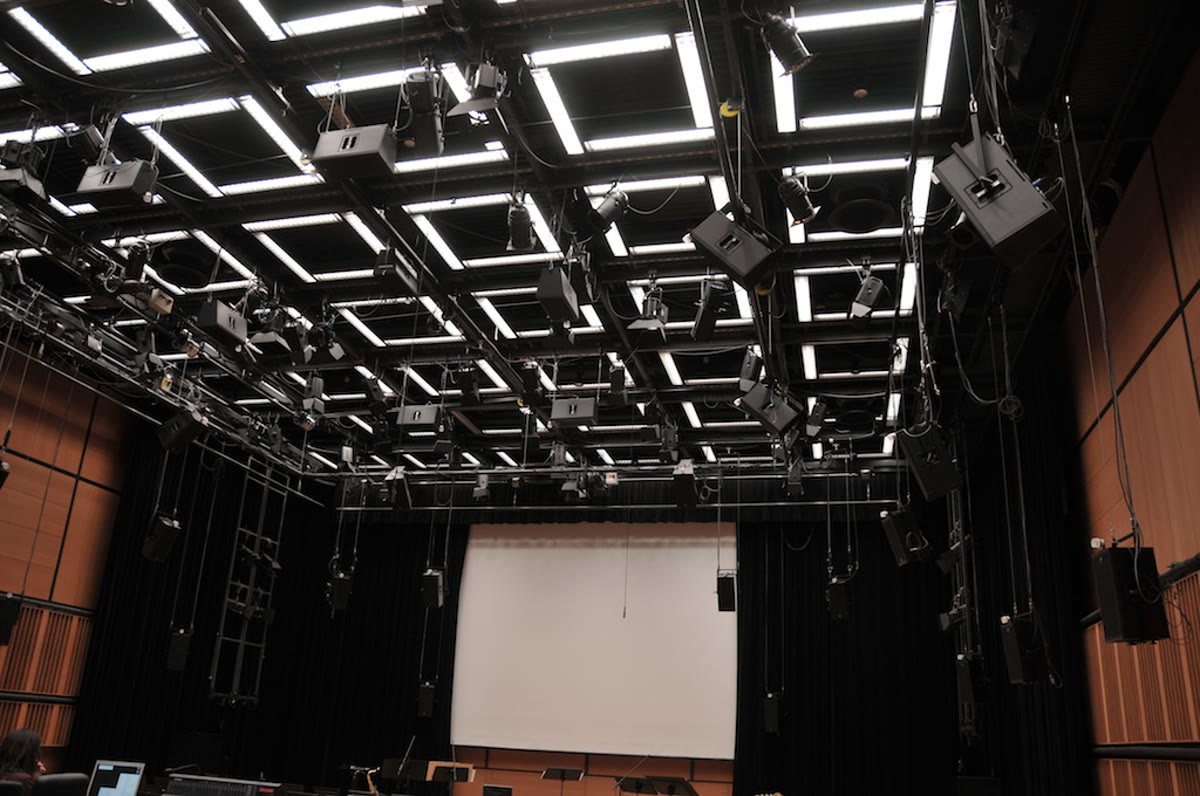
Loudspeaker array for the premiere of Ephemeron at ZKM, Karlsruhe
Ephemeron at ZKM, Karlsruhe.
Ephemeron, interactive music installation
Ephemeron, interactive music installation.
Premiere of Ephemeron setup in ZKM Centre, Karlsruhe
Premiere of Ephemeron setup in ZKM Centre, Karlsruhe.
Specification

Technical details

Medium
For self-organising electronics. A work of music/interactive sound installation.
Materials (room version)
4-8 speakers; 2-4 omnidirectional microphones; 2-4 microphones' stands; 6-12 XLR balanced cables (for speakers and microphones); MAC; iPad (as a controller); sound card (inputs: 2 – 4 / outputs: 4 - 8 - RME fireface 400).
Dimensions
A dark space of medium size. Web version: it runs in any current browser, desktop or mobile.
Tools / software
Algorithm written in MAX / MSP. Web version: static HTML, CSS and JavaScript. No build step, no dependencies, no server-side component, no third-party request of any kind after load. The audio is computed client-side, so the piece performs wherever it is served.
Reading
The artist

Phivos-Angelos Kollias

Dr. Phivos-Angelos Kollias is a Berlin-based composer-music technologist. His projects incorporate cables, sensors, code, microphones, speakers, instruments, and any possible non-living object as interactive media.

He studied classical and electronic composition in Cambridge, London, and Paris and completed his PhD in interdisciplinary applications of self-organisation in interactive composition (Université Paris VIII), funded by the Onassis Foundation, National Music Library (Trianti), Greek Composers Union and Leventis Foundation.

His music is a dialogue between acoustic aesthetics, classical orchestration, noise sensibility, metal timbres, and electronic idioms; curiosity driven equally by the absurd, the ridiculous, interdisciplinary Complexity theories and artificial intelligence paradigms. Co-founder and artistic lead of Echorroes, a human-centred interactive music and AI initiative (nominated STARTS prize 2025).

His works have received ten awards and nine distinctions at international events (incl. FIVARS, Iannis Xenakis Competition, Musicworks, SEGNALI etc.). Collaborations include ZKM, Greek National Opera, National Library of Greece, Deutscher Musikrat, Musikfonds Berlin, Dell, Transmediale, Ars Electronica, and IMPAKT.

His compositional work extends into video games and VR installations, collaborative projects that have received twelve international distinctions, including Apple TV Game of the Year, the Gamescom Indie Award, as well as two mentions in Forbes lists.

Links